www.facebook.com/arcticdreamsband
Sounds like: Metal
All questions answered by Alex Y.
1. What's new with Arctic Dreams?
"So, after successfully warming up for HATE last September, we decided to finally gather our strength and finish our second full-length album. Work on it actually began back in November 2024, when our drummer Roman recorded his parts, but with how busy we all were, we simply couldn't find the time to complete it. Still, presenting fresh material was the logical next step for us.
You know, our first album, "And The Agony Has Started," lingered for a long time like unfinished business, and honestly, its material feels dated to us today. By that I mean we wouldn't write something like that anymore - we've grown as musicians, and our style has evolved along with us. That said, "And The Agony Has Started" has some strong moments that people still listen to, and it remains a snapshot of its time and a page in our history.
So with the second album, we decided not to let it drag on. For about half a year we stepped away from playing live and focused entirely on the record. We refined the arrangements, wrote orchestral parts we'd never used before, and - my own personal addition - choir parts. I used to use them sparingly, but there's plenty of them in the new material. This final push began in September 2025, and our second LP, "Letargin," was released on April 6, 2026.
We had planned major touring in support of it, but unfortunately we had to pass on many events due to circumstances mostly beyond our control. So far we've played a couple of shows - in Belgrade and in Niš - and we're now preparing for our set at Hellhammer Festival Open Air 2026 here at home in Serbia. But we're not giving up, and we're always on the lookout for new opportunities to perform.
And one more piece of news that means a great deal to me personally - while we were working on "Letargin," my daughter was born.”
2. What do you want listeners to take away from your new music?
”Well, first of all, as I already mentioned above, our arrangements have become more complex in places and more interesting, and the tempo of the compositions has generally gotten faster. Also, for the first time on this album, we experimented with a ballad - "And I Will Be Your Angel."
The material is fundamentally different from the first album. Where "And The Agony Has Started" was a collection of stories (for example, the one about the Saw and Gordon Freeman from Half-Life), "Letargin" turned out to be a concept album overall.
Running through the tracks is the story of a man who went through a war and can't escape it. The narrative begins with the protagonist defending a fortress against enemies ("Glory Forever"), then he ends up in the Dyatlov Pass incident ("Frozen Little Beings"), then he's carried back to the age of the Vikings and takes part in a raid ("Storm"), and after that we send him, conceptually, into an Orwellian dystopia ("2084"). The next composition, "Despot & Tyrant," is a monologue by an evil autocrat, a master of lives and souls, who poisons the hero.
And so, step by step, the listener arrives at the title track, "Letargin." Here the approach is completely unexpected: for one thing, the composition is very long, almost nine minutes, with a fairly complex symphonic arrangement, a slow section, and two guitar solos. The essence of the track is that our hero plays a card game against a character we invented - the Ace - trying to win himself peace and absolution from the horror of war that haunts him. The finale tells us that the hero has, after all, lost his soul to the Ace.
But let's continue our journey through the album. Having lost the game to the Ace, our hero decides to leave this world ("To Meet The Heavenly Light") and comes to his little daughter in a dream ("And I Will Be Your Angel"). After saying goodbye to her, the hero faces Judgment ("Second Circle"). "Second Circle" was based on Dante Alighieri's Divine Comedy. And the final composition - the hero comes before the Slavic goddess of death, Morana ("Morana").”
3. Out of all of the years you've been together, what are the top three moments with the band that blew you away?
”I can't say we've spent a lot of time together, unfortunately. The members we started Arctic Dreams with more than 15 years ago have scattered around the world, and with many of them I don't even have contact anymore. And since we became active again in the current lineup, a lot of members have changed, so I can't say we spend much time together either.
That's why I think it makes more sense to answer what struck me personally, as the founder and the driving force behind Arctic Dreams.
First of all, I was struck by how far the level of modern technical solutions for musicians has come. My life worked out in such a way that I was performing actively from 2007 to 2011, and then I had a huge break. We only started performing again last year. And you know what I'll tell you? It was significantly easier for me to get back into live activity. We were able to afford professional equipment that either didn't exist 15–20 years ago, or if it did, cost astronomical money.
The second thing was probably the show with the Poles in HATE. For the first time we got to watch how a professional metal artist works, from the moment of load-in to the moment of load-out.
And the third moment happened recently, when we started arranging shows and tours outside our Serbia. We found out the hard way how much it takes out of you in nerves, money and time - and what a swamp it is in general.”
4. What's been the inspiration behind your music artwork?
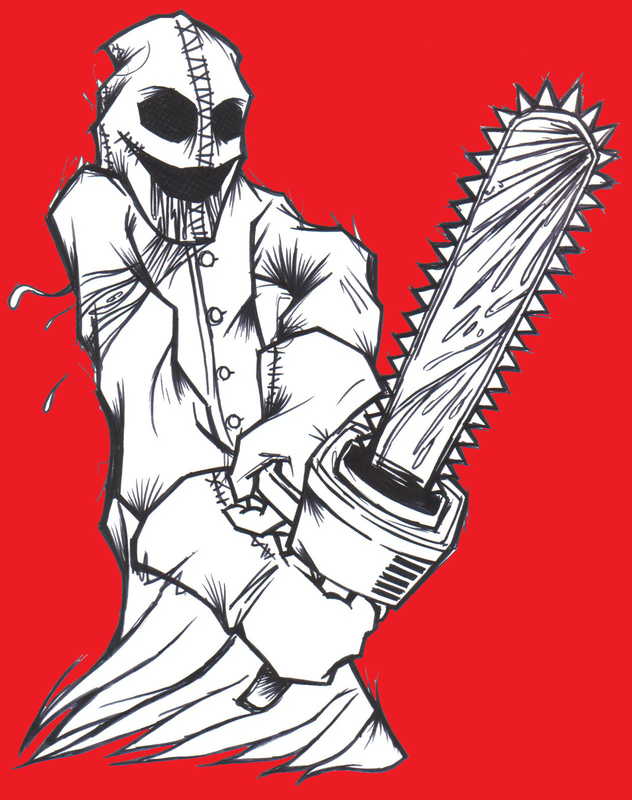
”The cover features the protagonist of the story and the Ace looming over him. By the way, we're thinking of making him our mascot - maybe.”
5. What advice would you give to an up and coming band?
”I’d advise them to find a good job. Or some other good source of income. Because when you start a metal band, you need a lot of money. A lot. I’d also advise them not to expect immediate success. Because before you see your first successes, you have to go through fire, water, and copper pipes.”
6. What's your favorite track of yours to play live and why?
”This will be the title track from the new album, Letargin. The song is very long, featuring an acoustic section, a rich symphonic arrangement, and several solos.”
7. What's your thoughts on AI in music?
”Oh, this is a huge topic. Honestly, it deserves a separate interview of its own, ha-ha. I've gone so deep into it that one weekend I sat down and wrote out all my thoughts on the subject in something like a small brochure.
Look, I have a fairly interesting and unusual vantage point: on one hand I'm a programmer, and right now I'm working on integrating AI everywhere I can; on the other hand I own a recording studio where we record live music. And here's what I can tell you: modern AI is excellent at solving business problems quickly and at lower cost, but it has nothing to do with creativity. Any neural network, whether it's a language model or generative AI, produces its output based on the millions of samples it has copied into its memory.
But unfortunately, technological progress can't be stopped, and I think its effect on music is bad. First of all, digitalisation on its own has been bad for music. It's now available at any moment on streaming platforms, and it has turned from a cultural value into the background noise of everyday life. You no longer have to search for, order and wait for a vinyl record, a cassette or a CD of your favourite artist's album - everything is already there in Spotify on your phone. And with the arrival of Suno, absolutely EVERYONE can make music, which kills the whole point of starting a musical project.
You'd think that was the end of everything, but no. For one thing, I'm glad that platforms and labels have started tracking, labelling and removing AI-generated music - life has become a little easier. Even before that, the accessibility of technology meant a huge amount of music was being released, and with AI-generated music that volume has grown exponentially. So it's become extremely hard for a real artist to get their music through to a listener. These days you have to put in a lot of effort and money just so your fan actually hears you.
Second, speaking specifically about metal, the community of metal fans is conservative by nature - fortunately. It's hard to sell them mass-produced filler; it gets rejected immediately, with rare exceptions. Yes, neural networks have now reached a level where you can't tell on first listen whether something was generated or recorded. But I've noticed again and again that you listen to AI music exactly once, and you never want to put that track on again. Simply because it sounds like ten thousand other tracks just like it.
Let me take this thought a bit further. Why do we have all these legendary artists and their recordings from the '70s, '80s, '90s and 2000s - the pre-digital era? Why do we still listen to them every day, and why are they still headlining festivals and filling halls and arenas on tour? Because in their time everything was analogue: the recording was done on tape and the mixing was analogue too. It was hard work, but those recordings were UNIQUE. Because so many factors shaped them: the artist's mood, their way of performing, the mains voltage at that particular moment, even faults in the equipment. Every one of those nuances was a brushstroke of that uniqueness. And what does a neural network do now? It just takes that uniqueness and copies it on the user's prompt. Where's the creativity in that? What is the listener supposed to be paying for?
You know what I think about all this? That the metal listener is getting more and more tired of this whole digitalisation of music. Which is why you have to record as much as possible live, and show the listener that you're making this music live, in order to earn their trust. At any rate, that's the direction we've chosen for Arctic Dreams.”
8. Out of all of the physical formats that are creeping back up in popularity like cassettes, CDs and of course vinyl, which one do you prefer as an artist and also as a fan?
”All three. Each format, in its own right, is part of our culture. You know what's important? We need to instill these formats in our children. ”
9. What do you want to accomplish before the end of 2026?
”To be honest with you - I don’t know. We originally planned to release an album and tour in 2026 and 2027, but so far, things haven’t gone at all as we planned. For now, we’ll take it one step at a time and keep you and our fans updated on what’s happening. Thanks for the interview!”